Machine Learning
Teaching a computer to pick up patterns from data and use them to make predictions, instead of writing every rule by hand.
Quick summary
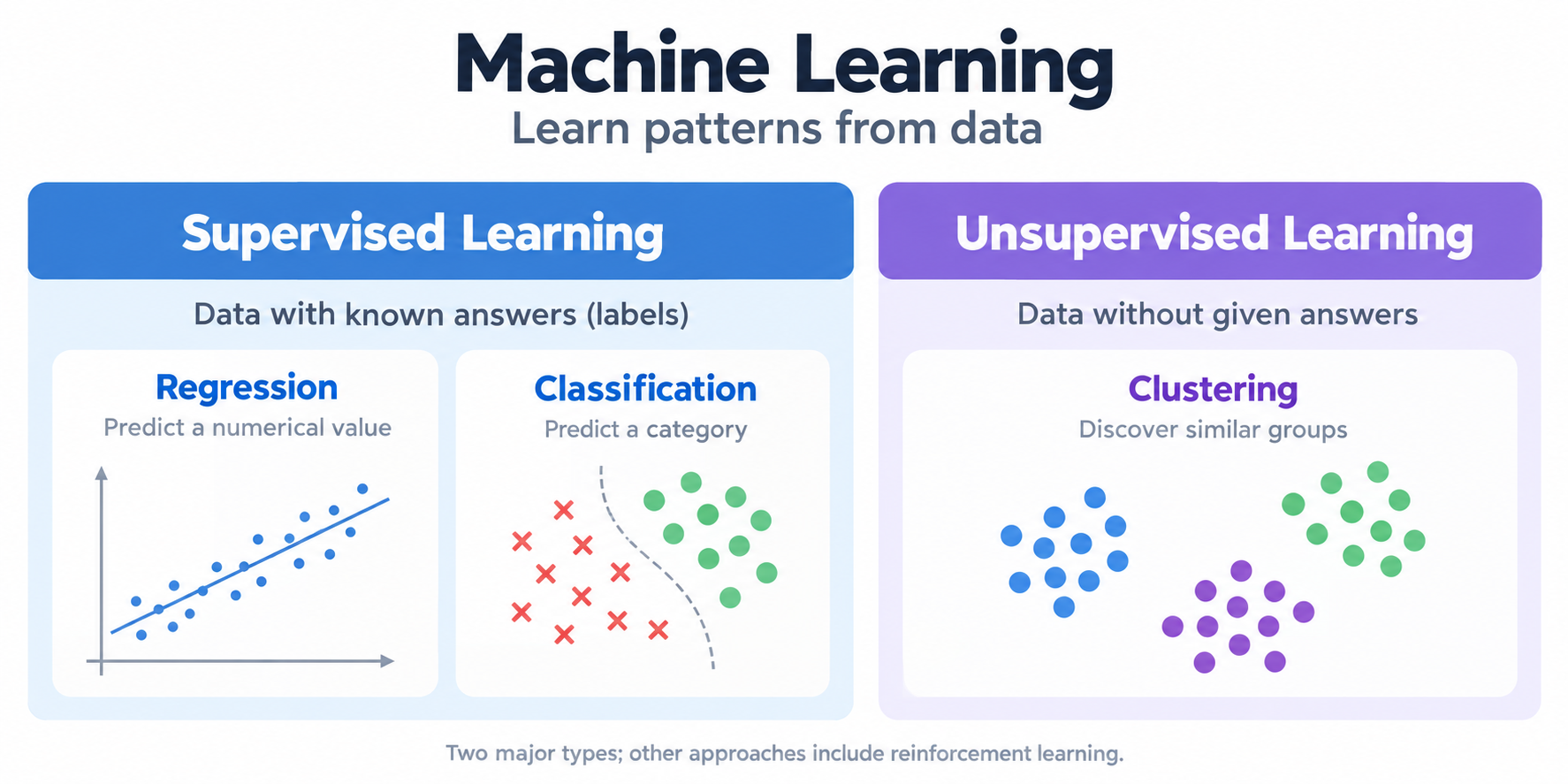
Two main types:
- Supervised learning: learns from data that has the answers (labels).
- Unsupervised learning: finds patterns in data with no answers given.
1 Supervised learning
You give the model examples with an input (x) and the right output (y). It learns how they relate, then predicts y for a new x.
- 1.1 Regression: predicts a number, like a house price.
- 1.2 Classification: predicts a category, like spam or not spam.
2 Unsupervised learning
You give the model data without labels and it finds structure on its own, like grouping customers who shop the same way (clustering).
- 2.1 Clustering: groups similar examples together.
- 2.2 Anomaly Detection: spots examples that don’t fit the usual pattern.
- 2.3 Dimensionality Reduction: describes each example with fewer numbers but keeps what matters.
3 Linear regression
A closer look at the simplest model, a straight line fitted to data.
- 3.1 Training Data and Notation: the symbols used to describe training data.
- 3.2 From Data to a Model Function: from plotting data to a trained function that predicts ŷ.
- 3.3 Cost Function: one number that says how well a line fits.
Remember
Supervised = learn from known answers.
Unsupervised = find patterns with no answers given.
There are other types too, like reinforcement learning, where an agent learns by taking actions and getting rewards.